Monday, September 27, 2010

Puye Cliffs

Earlier this summer I toured the Puye Cliff Dwellings which are located near Los Alamos, about 35 miles northwest of Santa Fe.  Puye Cliffs was the ancestral home of the people of Santa Clara Pueblo from the 900s until about 1580, when they moved to the Rio Grande Valley.  According to pueblo legend, a black bear wandered through the village, harming no one, and led the people 10 miles away.  Historians say the move to the river was occasioned by drought.


This site, now a National Historic Landmark, was closed from 2000-2009 due to flooding and erosion resulting from the Cerro Grande fire, which caused major damage to the Los Alamos area.  It has only recently reopened to the public, and it was exciting to finally have an opportunity to visit this beautiful site.

We had a terrific tour by a member of the Santa Clara Pueblo who guided us up pathways and ladders from the bottom to the top of the mesa.


Puye Cliff markingsThe cliff dwellings are on two levels with the bottom row about a mile long and the top level about 2,100 feet in length.  Cliff marking are still visible like the one in the photo above.  Many of these markings were the equivalent of directional signs.  


Puye mesa
Paths and stairways connected the two levels and allowed residents to get to the top of the mesa where additional dwellings were located.  The mesa dwellings were in the form of a multi-story complex built around a central plaza, though only crumbling walls (like those shown to the left) remain.


An interesting feature of the site is one of the original Harvey Houses.  These were a chain of restaurants/hotels that serviced train (and later auto) travelers to the Southwest.  There were more than a dozen Harvey Houses in New Mexico, though this one at Puye was the only one built on an Indian reservation.  The mother of a friend of mine recalls dining in the Harvey House in Santa Fe when they took the train from California to Maine in 1931.
Former Harvey House at Puye Cliffs


Wednesday, July 14, 2010

Gunfighting in New Mexico

Billy the Kid's grave markerI'm currently reading a book about Victorian America (part of my 1905 research) and came across some interesting statistics about gunfights. From 1870-1874, New Mexico had the third largest number of gunfights in the U.S. (states and territories), behind Kansas and Texas. In the next five years, New Mexico was second only to Texas--with 23 gunfights in New Mexico in 1878 alone. In 1880-1884, New Mexico earned the dubious distinction of being #1 in the gunfighting derby.

The 1878-1881 period in NM was known for the Lincoln County War in 1878, and the Dodge City Gang which terrorized Las Vegas from 1879-1880. Several gunfighters from the gang headed out of town to Tombstone, Arizona after a vigilante party of townspeople was formed, though some returned to NM in the next few years. Billy the Kid, present for the Lincoln County War, was killed in Fort Sumner, NM by Sheriff Pat Garrett in 1881.

The number of gunfights in the US forms a neat bell curve--starting with 13 in the period from 1854-1859, peaking at 106 in 1875-1879, and dropping off to 9 by 1910-1914.

In 1908, for example, there were only four gunfights in the US--though two were in New Mexico. One of the remaining two was the fight between Bolivian soldiers and Butch Cassidy and the Sundance Kid. (This was counted as a US gunfight since two of the protagonists were Americans.)

Still, I guess it's all in what you count as a gunfight. An 18-year-old boy was shot to death by a 16-year-old in the parking lot of the Santa Fe Place mall this week--a fight over a girl apparently. So it's not quite over yet.

Illustration Credits and References

Statistsics on gunfighting appeared in Almanacs of American Life: Victorian America 1876-1913 by Crandall Shifflett (1996); the author credits Encyclopedia of Western Gunfighters by Bill O'Neal (1979) for this data.

Other information from the Legends of America website.

Photograph of Billy the Kid's death marker courtesy of chucksville.org

Sunday, June 06, 2010

The White Sisters' Legacy

SAR Reception CenterIn April I was able to tour the School for Advanced Research (SAR) in Santa Fe, a truly fabulous piece of property which houses this unique institution.

SAR got its start in the early years of the 20th century as the School for Archaeological Research, and it was headed by anthropologist Edgar Lee Hewitt from 1907 until his death in 1946. (He simultaneously headed the Museum of New Mexico after it was established in 1909.) SAR's mission was to train students, conduct anthropological research on the American continent, and preserve and study Southwestern culture.

Meanwhile, wealthy NY socialite sisters Martha Root White and Amelia Elizabeth White discovered Santa Fe in 1923. Both had graduated from Bryn Mawr, and served as Army nursing assistants during World War I. They found Santa Fe on a cross-country trip, and bought a large property here in the city. They built a home which they called El Delirio ("the madness"), and over the years the compound grew to include a kennel, guest houses, a swimming pool, and a variety of other structures.

SAR, El Delirio, White SistersEl Delirio became a gathering place for artists, writers, and intellectuals, and the White sisters are said to have thrown some stunning parties in the 20s and 30s. Their home was the setting for lavish dinners, concerts, poetry readings, pool parties, plays, and masquerade balls.

Guests of the White Sisters at El Delirio Santa FeFive women, including poet Alice Corbin Henderson, second from left, display their costumes at the swimming pool dedication ca. 1926.

The sisters also bred and raised Irish wolfhounds, and a cemetery for their beloved dogs can be seen on the grounds today.

Elizabeth helped to establish the Old Santa Fe Association, the Laboratory of Anthropology, the Wheelwright Museum, the Garcia Street Club, and the Santa Fe Animal Shelter--and all these organizations are still active.

El Delirio, Santa FeThe sisters were patrons and promoters of Native American Art and they opened the first Native American art gallery in New York City. Elizabeth was a founding member of the Indian Arts Fund in 1925, an organization which focused on buying up Indian pottery and other handcrafts to preserve these artifacts for future generations. She also served on the SAR managing board for 25 years.

Martha died in 1937, but Elizabeth lived to be 96 years old. And when she died, in 1972, she left El Delirio and its remaining acres to the School for Advanced Research, giving that institution its first permanent home. That same year, the Indian Arts Fund also disbanded and deeded its collections to SAR.

SAR Resident Scholars Dining RoomThe Resident Scholars' communal dining room--all set for delicious food and stimulating conversation.

Today, SAR runs an advanced seminar series and a resident scholar program. The latter has provided over 160 pre- and postdoctoral scholars with nine-month residencies in which to read, reflect, and write up research results. A key part of the program is the unique intellectual interaction which takes place among scholars from different but related disciplines. Native artists have the opportunity to do residencies on site while they work on their art. SAR also houses the IAF collections and a state-of-the-art archaeological repository, and the SAR Press produces books on archaeology, anthropology, and Southwestern art and culture.

White Sisters MemorialThe mausoleum for the White sisters.

The grounds are beautiful, and a tour provides a look at SAR as it currently exists, and historical views of both SAR and the life of the White sisters.

White Sisters Dog CemeteryThe cemetery for the White sisters' Irish wolfhounds--each dog is identified by name.

Illustration Credits and References

Photo of the White sisters' party at El Delirio courtesy of the SAR website (sarweb.org). All other photographs by the author.

Wednesday, April 07, 2010

Santa Fe Municipal Airport

American Eagle plane in Santa Fe
When I first moved to Santa Fe, a couple of commercial flights were available from Santa Fe to Denver, but those were eventually discontinued. In June 2009, American Eagle instituted three flights a day--one to Los Angeles and two to Dallas. When a third flight to/from Dallas was added in February of this year, it became possible for eastbound passengers to make connections to and from Dallas, and I decided to give it a try.

Gate at Santa Fe Municipal Airport
The Santa Fe Municipal Airport is a charming step back in time. It was designed by noted Santa Fe architect John Gaw Meem, and constructed in 1957, in the southwest corner of the city. Its interior is full of southwestern accents.

Interior of terminal Santa Fe Municipal Airport
It has one counter, one security line, one restaurant (The Airport Grille), one waiting room, and one gate. Parking involves writing a check for $3 a day for the duration of your trip and sticking it in an envelope in a box inside the terminal. "The Eagle has landed" heralds the arrival of the plane, and the gate agent greets arriving customers with a cheerful "Welcome to Santa Fe!"

Exiting the plane at the Santa Fe Municipal Airport
Unfortunately, my travel experience was less than optimal due to weather-related interruptions at both ends (which caused me to miss my connection in Dallas and rerouted our return flight to Albuquerque due to wind, snow, and ice at the SF airport). But I am giving it another chance in May. It's so convenient--a 15 minute drive and no shuttle buses to the terminal required!

Santa Fe Municipal Airport
Photo Credits

The photograph of the terminal interior comes from the Veritas et Venustas blog by architect, urbanist, and author John Massengale. All other photos by Catherine Hurst.

Monday, March 08, 2010

Santa Fe School of Cooking

Chef Danny Cohen Santa Fe School of Cooking
I had the opportunity a couple of weeks ago to attend a "bonus" class at the Santa Fe School of Cooking. The School is a 20-year fixture in Santa Fe, and its bonus classes, aimed at the locals, are test classes where the School and its chefs have an opportunity to try out new themes and ideas, and practice for the more formal (and more expensive!) classes come tourist season.

This was the third such class I've attended in the last couple of years--the first was a southwestern-themed brunch, and the second was a class featuring foods appropriate (by theme and portability) for tailgating at upcoming summer operas.

Our recent class featured four different kinds of chiles rellenos (stuffed chiles): cream cheese stuffed jalapeños in escabeche, New Mexican tempura rellenos, ancho chile rellenos, and chiles en nogada.

The last was my favorite. It featured a stuffing that included ground pork, garlic and onion, tomato puree, apples, peaches, plantains, dried apricots, raisins, and almonds. And as if that weren't enough, it was accompanied by a sauce made from pecans, almonds, queso fresco (or feta cheese), half and half, and sherry. The chiles were stuffed, lightly battered, fried, dipped in sauce, and topped with pomegranate seeds. Scrumptious!
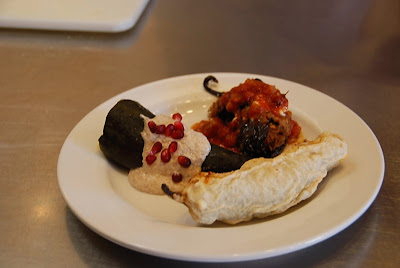
Santa Fe School of Cooking Chiles Rellenos
Our chef for the day was Danny Cohen, ably assisted by Noe Cano.

Danny Cohen and Noe CanoAnd "class" is really not the right word for this experience--it's really a demonstration. The chef (who also teaches culinary classes at Santa Fe Community College) kept up an engaging patter while he cooked, and we could all see what he was doing in the reflection of the overhead mirror.

Mirror observation Santa Fe School of CookingWe students drank coffee and wine, took notes, and ate--a very easy assigment!

I even learned a couple of new cooking facts/tips. For example, fresh jalapeños become chipotles when dried, and poblanos become anchos. And Chef Danny prefers the use of grapeseed oil for cooking (as opposed to canola oil), with olive oil only used to finish.

They do also offer hands-on classes, restaurant walks featuring private chef meetings and tastings in some of the best restaurants in Santa Fe, an onsite market for Southwestern foods and cooking tools, and one or two day team building seminars centered around the experience of cooking and eating together.

I highly recommend the Santa Fe School of Cooking, in spite of the steep price-tag ($70 and up for most classes). Visit in February and enjoy a "bonus" class!

Photo Credits

All photos in this post were taken by my friend and fellow student Linda McIlroy.

Monday, February 01, 2010

In Praise of the Sidecar, Part 2

Sidecar on the menu at McCormick & SchmickAlmost exactly two years ago in this blog, I wrote a paean to my favorite cocktail, the sidecar. I promised I would get to history (the sidecar's and mine) eventually. . . . In January I had a wonderful elderflower sidecar at McCormick & Schmick's in Boston which prompted me to get back to the rest of the story.

Generally accepted bartending lore assigns the origin of the drink to a time period near the end of World War I. The place was either London or Paris, and the inventor was an American Army captain who was driven to and from his local watering hole in the sidecar of a motorcycle. The drink was first mentioned in a bartender's guide in 1922, and 1934 was the first recorded recipe with a sugared rim (my preferred presentation).

Elizabeth Bowen, in The Death of the Heart (published in 1938), offers the cocktail to one of her characters:

Indoors, among the mirrors and pillars, they found Mr. Bursely and Daphne, cozy over a drink. Reproaches and rather snooty laughs were exchanged, then Mr. Bursely, summoning the waiter, did what was right by everyone. Clara and Portia were given orangeade, with hygienic straws twisted up in paper; Daphne had another bronx, Evelyn a side-car. The men drank whisky. . .

The cocktail was popular through the sixties, but faded in the seventies and eighties. Karen Kijewski, in her mystery novel Katwalk, published in 1989, laments their demise:

"Hey, Kat." I turned. "What's in a sidecar?"
"Huh? Oh. Brandy, Triple Sec, sweet and sour and lime--with a sugar rim and a cherry. Nobody drinks them anymore."
He grinned and waved and I waved back, at him and at the memories.


But by the 90s, cocktails in general were coming back in style; an article in the Boston Globe in 1994 describes the scene at a local lounge:

At the bar, the young couple put down their drinks--he with a cubana (sugar syrup, lime juice, aproct brandy, rum), she with a sidecar (Cointreau, lemon juice, brandy)--and step out on the floor to tango.

Another Globe article, six years later, is titled: "Sidecar cocktail rides again." A 2004 Boston Herald headline boasts that the "Sidecar takes back seat to no other cocktail."

Sidecar in New York Times crossword puzzle
And the cocktail was sufficiently mainstream to appear in a NY Times crossword in 2007.

I have been faithful to the sidecar since 1966, and in a future post I'll talk a bit about my history with the drink.

In the meantime, you can watch this video of Rachel Maddow shaking up a sidecar in a New York bar.

Saturday, December 19, 2009

Gruene, Texas

Gruene Mansion Inn"Gently resisting change since 1872."

That's the tagline for the village of Gruene, Texas. Located midway between Austin and San Antonio, it features a whole community of 19th century residences and businesses, which owe their survival to the Depression.

But before that, Henry Gruene built a home for himself and one for his foreman, a cotton gin, a "mercantile", and a dance hall/saloon. Business thrived in the late 19th and early 20th centuries, but after a major boll weevil attack and the sorrows of the Depression, the town was largely abandoned. As a result, 1970s restoration efforts had a treasure trove of original architecture to work with, and today the town evokes its origins in several streets of quaint shops, antique stores, and the original dance hall--Gruene Hall. (Unlike the rest of town, the dance hall/saloon never closed!)

Bill HearneOn a recent trip to San Antonio, we detoured to Gruene to listen to Santa Fe musician Bill Hearne in the dance hall, meet an Austin friend for lunch, and tour the town. One of the things I really enjoyed was the wordplay in the naming of the shops, restaurants, etc. Though the original German name would have been pronounced "Groon'eh", the locals pronounce it "Green"--and that's how you have to read the signs in this post.

Tavern in the Gruene
Gruene with Envy
Gruene Apple
Gruene Leaf
Gruene Door
Tickled Pink in Gruene

Wednesday, December 16, 2009

Institute of American Indian Arts

Mountains near Santa FeLast week I had the opportunity to tour the campus of the Institute of American Indian Arts--a four-year tribal college in Santa Fe. IAIA is the only U.S. arts college dedicated to the traditions and culture of the American Indian, and is set on a stunning 140 acres just outside of the city limits. On the day we visited, the layers of mountains circling the campus were snow-covered and the sky was bright blue, creating a wonderful canvas.

The IAIA was founded in 1962, and was first located on the grounds of the Santa Fe Indian School. The Institute includes both the college, and the IAIA museum in downtown Santa Fe.
IAIA Campus, Santa Fe
IAIA Campus, Santa FeAbout 375 students are currently enrolled at the college and they represent roughly 100 different tribes from the mainland U.S. and Alaska.

Over the nearly 50 years of its existence, the IAIA has been home to students from about 90% of the recognized native American tribes. And about 15% of its students are non-natives who've come to IAIA to study native art traditions.

The IAIA's location is ideal for furthering its mission--in Santa Fe, which is the second largest art market in the U.S., and near the 19 native pueblos of New Mexico. In addition, the size and setting of the campus allowed it to be constructed in a way that references and respects native traditions (directions, solstices, etc.), and it is home to native plants and wildlife. On-campus housing includes residences for traditional-age students, as well as family housing units for older students. A new daycare center is expected to open soon.

IAIA Campus, Santa Fe
All facilities are full of native art, and our tour included views of studios and galleries, and art that included painting, metalwork, jewelry, glass, beading, and leatherwork.

Native American Last SupperThis painting by an IAIA student, a Native American version of the Last Supper, was hanging in the Administration building.

Wheel by Bob HaozousThis spinning wheel in the IAIA library is by Apache artist Bob Haozous, son of Allan Houser (whom I've written about in an earlier blog).

One of the highlights of our trip was the welcome our group received in the student learning support center, where we were treated to a snack of hot blue corn meal (in a form somewhere between oatmeal and hot drink); a note on the blackboard in the student lounge area indicated that it was a "blue corn morning". Thus warmed and fortified, we were able to venture back out into the cold to complete our tour of this impressive facility.

Wednesday, November 11, 2009

Honoring the Navajo Code Talkers on Veterans Day

Navajo Code Talker Lemuel YazzieNavajo Code Talker Lemuel Yazzie. AP Photo/Seth Wenig.

Today, 13 of the famed Navajo Code Talkers from World War II will participate for the first time in the New York City Veterans Day parade.

This Marine unit used Navajo language-encrypted military terms in a code that was never broken by the Japanese. One of the things that made it so hard to break was that different words could be used for exactly the same message. The Navajo were sworn to secrecy about the code, and kept their secret long after the code was declassified in 1968.

There were about 400 Code Talkers in all; it is believed that about 50 are still alive--most living in the Navajo Nation, which is located in northwestern New Mexico, northeastern Arizona, and southeastern Utah. (Navajoland, or Diné Bikéyah, covers 27,000 square miles, which makes it larger than many U.S. states.)

Recognition for these brave Marines was slow to come. In 2000, the Congressional Gold Medal was bestowed on the survivors of the original 29 Code Talkers, and silver medals on the rest. The Navajo Code Talkers Foundation is creating a museum in their honor which is expected to open in New Mexico, near the Navajo capital of Window Rock, Arizona in 2012.

Navajo Code Talkers Veterans DayNavajo Code Talkers (from left) Lloyd Oliver, Bahe Ketchum, and Joe Vandever. AP Photo/Seth Wenig.

New Mexico Senator Jeff Bingaman has devoted part of his website to information about the Code Talkers; click here for more information.

Saturday, October 10, 2009

Sun, Clouds, Mist, and Aspens

Aspen Vista Trail
On October 8 we did our annual hike of the Aspen Vista Trail. In contrast to the blazing sun of the past two years, this was a cooler and less sunny walk, but beautiful still the same.

We lucked into a wonderful window of reasonably bright weather combined with threatening skies--which made for some great shadows and colors.

I would say that we were a few days past peak--good color on the lower and more protected slopes (at about 10,000 feet) but lots of lost leaves as we climbed higher.

Aspen Vista Trail
Aspen Vista Trail
Moments before we left (the temperature had already dropped about five degrees) a heavy, cold mist blew in. The time between the first and last of the following photographs was no more than four minutes--in the first you can see the entire valley from the parking area; by the third. the valley has been totally obliterated.

Aspen Vista Trailhead
Aspen Vista Trailhead, Snow Coming
Time to hop in the car and go home! The mountain was covered in clouds the rest of the day, but the next morning we could see that the peak was clearly snow-covered.

Aspen Vista Parking Lot
Click the links to read about our 2008 and 2007 walks, with lots more detail on the Aspen Vista Trail!