Thursday, December 27, 2007

River of Lights

For the past ten years, the Rio Grande Botanic Garden in Albuquerque has been the site of the "River of Lights", a holiday-themed display of lights open to the public in the evenings from Thanksgiving to December 30. A few days before Christmas I visited the site, and although it was quite cold (20-ish?), we spent two happy hours wandering around the curving walkways, greenhouse, and water features, viewing the hundreds of thousands of lights, multiple toy train sets, and various singing groups.

Proceeds from the admission fee go to fund the BioVan, an educational outreach program that visits the Albuquerque elementary schools and teaches kids about the Rio Grande, and the plants and animals that form part of its ecology.

I took all these photos at night, without flash--the light and color of the displays is phenomenal, and the photos don't quite do the experience justice, but you get the idea!


Tuesday, December 18, 2007

Happy Holidays from New Mexico!

Every year during the month of December, the New Mexico Governor's Mansion opens its doors for a series of holiday open houses. Located about 15 minutes from the "Roundhouse" (New Mexico's capitol building in Santa Fe), the Mansion is home to presidential candidate (and governor when he's in town) Bill Richardson and his wife.

According to our tour guide, the 10,000 square foot residence reserves about 4,000 square feet for the first family, and the same amount for its public rooms. The remaining 2,000 square feet is dedicated to the security staff and equipment. The property includes a stable, a tennis court, and extensive grounds.

When we arrived at the Mansion, we were welcomed by the greeter, entertained by musicians, and served hot cider and bizcochitos. We did not see ALL of the public spaces, but we did get a look at the beautiful living room, dining room, and study, which were decorated for the holidays to rival any Junior League Show House! A feature of the living room decor was a guitar signed by the Eagles--apparently Richardson is a big Eagles fan. (We're talking the band here, not the football team....)

So Bill and I wish you a happy holiday season from New Mexico!

Sunday, December 09, 2007

Women of the West, Part 3

A brief mention of Maria Gertrudis Barceló (aka "La Tules") in Andy Lovato's Santa Fe Hispanic Culture, one of the texts for the class in the American Southwest that I took this fall, inspired me to find out a bit more about her.

According to Lovato, "Tules" is an affectionate diminutive of Gertudis. La Tules was born in Sonora, Mexico in 1800, and moved into the New Mexican territory as a child with her younger sister and widowed mother. She married Manuel Antonio Sisneros of Tomé in 1823, and in 1825 moved with him to a mining camp near Santa Fe. She started a gambling house and saloon at the camp, which she later relocated to West Palace Avenue, at the corner of Burro Alley, in Santa Fe. According to contemporaneous sources, the "Sala" was an opulent and popular facility, and Doña Tules (the Spanish equivalent of "Miss Trudy") was a renowned Monte dealer. She amassed a fortune from her business dealings during the 1830s and 1840s, which included trade deals and investments in addition to her income from gambling.

She was described as charming, beautiful, fashionable, shrewd, witty, and brilliant. She was also politically influential--during the 1840s she was a close friend (and probably mistress) of Manuel Armijo--the last Mexican governor of New Mexico.

Doña Tules, like a number of other New Mexicans, sided with the Americans when the US declared war on Mexico in 1846. She loaned money to Gen. Kearny to help him meet his payroll, supposedly in return for receiving a military escort to the Victoria Ball at the La Fonda Hotel. She also apparently alerted US authorities to a Mexican/Indian conspiracy in late 1846/early 1847. Her "Sala" undoubtedly provided a cultural bridge between the Americanos and the Nuevomexicanos, and she certainly was repaid her loan to the Army by the gambling losses of American troops!

La Tules died in 1852, leaving three houses, livestock, and cash to various family members, as well as money to the Church and city officials to be used for charitable purposes.

A highly fictionalized and romanticized account of her life is the subject of Ruth Laughlin's 1948 novel, The Wind Leaves No Shadow. The true history is harder to find! In an 1950 article in El Palacio, the historian Fray Angélico Chávez set out to find out the truth about her, which he reported as "new but not sensational." According to Chávez, her fellow Santa Feans (including church and community leaders) were tolerant and accepted her for her good deeds and status in the community. According to Chávez, "to the Latin there was nothing in the law of nature or in the scriptures that labeled tobacco, liquor, or gambling as sins in themselves. . . These activities were pleasant forms of recreation and relaxation and of social well-being."

Note on 12/13/07: A recent biography by Mary J. Straw Cook, Doña Tules: Santa Fe's Courtesan and Gambler, a book I discovered after my original post on this topic, may shed some more light on this fascinating figure.


Illustration Credits

The black and white engraving above of La Tules smoking a cigarrito (powdered tobacco rolled in pieces of corn husk--with all the materials carried in a pouch at the waist) was made in 1854, two years after her death, for Harper's Weekly.

The illustration of La Tules dealing cards at her gambling house was done by Bill Hughes for New Mexico Magazine in 1971. Here he depicts his subject as she was described by Susan Shelby Magoffin in 1846, "a stately dame of a certain age, the possessor of . . . that shrewd sense and fascinating manner necessary to allure the wayward, inexperienced youth to the hall of final ruin."

The illustration at the top of this post is a more recent one by Diana Bryer, commissioned by La Herencia, a magazine of New Mexican heritage and history. Bryer says of her subject: "She was the wealthiest woman in the Territory, a successful business owner, . . . an emancipated woman and a role model for others, although the easterners who came to Santa Fe judged her by their own puritanical standards. I decided to portray her with a cigarette in her mouth because at that time smoking was a symbol of liberation for women. I tried to be as accurate and historically correct as possible in depicting the furnishings and clothing from the era, since Doña Tules set a fashion trend that was admired by many local women, and may well have contributed to the 'Santa Fe Style' still popular today. . . . Her shawl is from Spain circa 1822; at her side is her reputed lover and confidant, Governor Manuel Armijo. Also standing next to her is Padre Felipe Ortiz, the Vicar of Santa Fe. . . . Sitting on either side of the table are an eastern trader and a Native American trapper."

Thursday, November 29, 2007

What is the O'Keeffe Museum Thinking?

Photo courtesy of Fisk University

This is a tale of what I consider to be very bad behavior by the Georgia O'Keeffe Museum in Santa Fe.

The History

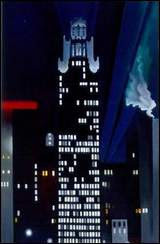
In 1949, Georgia O'Keeffe divided the art estate of her late husband Alfred Stieglitz among a number of institutions. One of the recipients was Fisk University, a historically black college in Nashville, Tennessee. The school received 101 paintings from O'Keeffe including her own Radiator Building--Night, New York, painted in 1927, and a number of other valuable works.

Like many small private colleges, Fisk has struggled financially in recent years. Protection and display of the valuable art collection was always an issue--O'Keeffe paid to send the entire collection sent to New York for restoration in the 1970s, and before her death donated tens of thousands of dollars for maintenance of Fisk's Van Vechten Gallery and the donated works.

But the gallery was a building constructed in 1888 and formerly used as a gymnasium; the college was no longer able to guarantee protection of the works there and the paintings were put in storage at the Frist Center for Visual Arts in Nashville in November 2005.

The following month, Fisk sought to sell Radiator Building, its most valuable painting, along with Painting No. 3 by Marsden Hartley. The sale of these two works would, the college believed, allow it construct a new science building, make needed campus repairs, replenish its hemorrhaging endowment, and appropriately protect and display the other 99 pieces of art, which include works by Picasso, Renoir, and others.

Listen to the details in this 2005 NPR story.

The Dog in the Manger

Shortly afterwards, the Georgia O'Keeffe Museum in Santa Fe stepped on stage in this deal. The Museum got involved by virtue of the dissolution of the O'Keeffe Foundation in May 2005; the Foundation turned over all its assets to the Museum and asked that the Museum "step into its shoes" to protect the Stieglitz gift to Fisk. So the Museum started legal action to block the sale of the paintings, stating that Fisk was violating the terms of O'Keeffe's gift to the school.

And the Attorney General of Tennessee also became a party to this deal, representing the people of Tennessee, for whom these works were characterized as a cultural asset.

Christie's had appraised the O'Keeffe for $8.5 million in 2005, and the O'Keeffe Museum offered Fisk $7 million for the painting. A Tennessee judge gave the school 30 days to see if they could get a better offer that would allow them to keep the work in Tennessee. The judge eventually nixed the deal with the O'Keeffe Museum in April 2007. Several offers of $20 million or more had been received for the painting at this point, although none met the "undisclosed requirements negotiated between the university and the Georgia O'Keeffe Museum." But clearly $7 million was not a good deal for Fisk and Tennessee.

By August of this year, the Museum had agreed to drop the lawsuit, buy Radiator Building for $7.5 million, and give Fisk "permission" (how does that work?!?) to sell the Hartley on the open market. The Museum also agreed that if they sold the O'Keeffe within 20 years they would give Fisk half of any profits (wow--what generosity! And how do they get to sell it if they won't let Fisk sell it?), that they would lend the painting back to Fisk for 4 months every 4 years, and give them a high quality reproduction to use in the meantime. In wonderful lawyer-speak, the Fisk attorney noted that this was "not a sale--just a lawsuit settlement".

Alice in Museumland

Photo courtesy of Marshall/Star Telegram/SIPA

But while the settlement agreement was pending, Wal-Mart heiress Alice Walton offered Fisk a new deal. She would give them $30 million for a 50% stake in the entire collection. The works would be displayed half-time in the new Crystal Bridges museum she is building in Bentonville, Arkansas, and at Fisk the other half. The terms of the offer would also include $1 million for Fisk to renovate and upgrade their art gallery, as well as an art internship for a Fisk student. This seemed to me to be a real win-win offer--Fisk would get the money they needed, the paintings would stay in the South, the collection would be kept intact, and Fisk and the citizens of Nashville would have access to the paintings half the time. (This is in contrast to no access, which is the current state of affairs, since the paintings are in storage and not on display.)

With the Walton offer on the table, a Nashville judge vetoed the O'Keeffe Museum offer as detrimental to the interests of the people of Tennessee.

You Go, Hazel!

Photo courtesy of US Department of Energy

In October, the O'Keeffe Museum asked that the Tennessee judge block the deal with Walton. This was clearly not good news for Fisk. According to a 10/17/07 New York Times article by Theo Emery, "Fisk's president, Hazel O'Leary, said the university was being 'held hostage' by the litigation. 'Their intention is to bleed us to death,' she said. 'They know that time is not on our side here.'"

The O'Keeffe Museum now wanted (are you ready for this?) the entire collection removed from Fisk's control and sent to New Mexico.

WWGD?

1950 photograph by Carl Van Vechten, for whom the Fisk art gallery is named.

So what would Georgia O'Keeffe do? This seems to be at the heart of the various legal arguments. A trial is scheduled for February to decide whether Fisk's agreement to share the collection with Walton's Crystal Bridges (which is scheduled to open in 2009) is close enough to O'Keeffe's wishes to be approved.

On Tuesday of this week, Tennessee Governor Phil Bredesen weighed in on the issue. According to an article in the Tennessean, he is quoted as saying: "As a businessperson, I would be very concerned at the deal Fisk has cut with the museum in Arkansas." Bredesen says that estimates from art experts and insurers indicate the collection "could easily be worth $150 million. And $30 million for half of it is not a very good deal."

Crystal Bridges executive director Bob Workman says the price reflects the restrictions placed on the collection by O'Keeffe. "This is a creative, long-term way to satisfy Ms. O'Keeffe's demand that the collection remain intact, to provide needed funds for Fisk University and to keep this historic collection in the public domain."

Amen to that, I say. Fisk says that they may have to close in 2008 if the deal is not approved. They have mortgaged all of their buildings and other loan options have been exhausted.

Imagine how much money has been spent by lawyers on this case over the past two years--probably enough to keep Fisk open for a number of years to come. And it is hard for me to imagine that Georgia O'Keeffe would have wanted Fisk to close, or would have approved her namesake museum's attempt to hijack the work(s). In a 1949 article in the New York Times at the time of the original bequests from Stieglitz's estate, she stated that "after 25 years, the (pictures) can be sold if the institutions have no further use for them." What's not clear about that?

Friday, November 23, 2007

First Snow of the Season

Woke up this morning to see grey skies and several inches of snow on the ground. The temperature has been just about 30 degrees all day--with on and off spitting snow.

This shot was taken from my living room through my brand new sliding glass doors with incredibly clear new glass!

Wednesday, November 14, 2007

Movie Update

I've had lots of hits on this blog with folks looking for information on Renée Zellweger and the filming of Appaloosa in Santa Fe. After my first post on this subject, I did not have any personal encounters with this movie, or anything to post that wasn't already covered in the Santa Fe New Mexican. According to that publication, Santa Fe filming wrapped up last week, and Renée (according to folks who encountered her) was lovely, friendly, and a generous tipper during her stay in Santa Fe.

This week's report concerns the local filming of Brothers, which, according to the New Mexican (clearly my favorite source for local movie news!), is "a remake of a Danish flick featuring 'a man who is sent to fight in Afghanistan while his black-sheep brother cares for his wife and child.'" Sound stage work is taking place on campus at the Garson Studios, shown above.

Purportedly, the trailers shown in the photo below are the (drumroll, please) ACTUAL TRAILERS where the stars (Tobey Maguire, Jake Gyllenhaal, and Natalie Portman) hang out when they're not on set. No actual star sightings yet, but the campus is abuzz!

Monday, November 12, 2007

Labyrinth

Labyrinths are very popular in Santa Fe; I had never walked a labyrinth before I came here (if you don't count playing "jellyroll" hopscotch!) and I have walked four in the year and a half since I arrived. There is one in front of St. Francis Cathedral that is laid in cut stone in the style of the one at Chartres--that's next on my list!

(Click here if you want to learn about the difference between a labyrinth and a maze.)

Yesterday I was invited to attend a celebration of a new labyrinth in my friend Susannah's yard. After we were "smudged" with the scent of burning herbs, and had seen the labyrinth blessed by a local celebrant, my friend Elaine led us through the walk. There are 7 circuits in Susannah's labyrinth--it's a Celtic pattern. Each circuit has been laid with a different color of natural stone to loosely correspond to the red-violet spectrum, with pink stone in the center.

It was a beautiful afternoon; we finished with a potluck supper in the late day sun.

Saturday, November 10, 2007

Allan Houser, Sculptor

Last month I was lucky enough to go with a group on a private guided tour of the Allan Houser Compound and Sculpture Garden, just outside Santa Fe. On the grounds there is a museum/gallery, a bronze foundry, meeting rooms, the home where Houser's elderly widow still resides, and many trails with the beautiful sculptures (largely of Native American figures) created by Allan Houser.

There are only a few "open to visitors" days each year, but guided tours are available to groups by appointment--if you're in, or near Santa Fe, I highly recommend this visit; go to the Allan Houser website for more information. Our wonderful guide gave us a word portrait of Houser's life which was extremely evocative and touching; then walked us around the grounds pointing out various pieces of interest and telling us Houser's artistic biography at the same time.

When I saw the phenomenal output of this talented artist (who, incidentally, created most of his remarkable body of work after he "retired" at 61, until his death in 1994), I wondered how it was possible I had never heard of him--even many Santa Fe folk don't know about him.

Houser (whose original family name was Haozous) was born into the Chiricahua Apache tribe in 1914. His father, Sam Haozous, was with Geronimo's band when he surrendered to the US Army in 1886 in Mexico. Members of the tribe were held as prisoners of war for the next 27 years in Florida, Alabama, and Oklahoma. Allan was born shortly after his parents' release--the first child born to a tribe member after the Chiricahua were released from captivity. Click here to read Allan's full biography.

Here are some of the sculptures I photographed against the beautiful New Mexico skies.


Thursday, November 01, 2007

Oh You Red Sox!

I was in Boston last weekend (during the last couple of games of the World Series) and saw this banner at the Isabella Stewart Gardner Museum. Mrs. Gardner (aka "Mrs. Jack") was a colorful and influential Bostonian in the first quarter of the 20th century.


The biography.com website offers the following quick summary:

When the death of her two-year-old son (1865) was followed by a miscarriage, she and her husband went to Europe. After they returned (1868), ‘Mrs Jack’ soon established herself as the most flamboyant and sought-after hostess in Boston. At first her energies went into entertaining, interior decoration, gardening, travelling, and collecting friends and odds-and-ends, but by the late 1880s she set out seriously to collect great art. Assisted by (and subsidizing) Bernard Berenson, newly graduated from Harvard College, she began to purchase mainly works of the European Renaissance. To house her growing collection, she built an ambitious Italianate palazzo, Fenway Court. Incorporated as the semi-private Isabella Stewart Gardner Museum (1902), it was opened to the first select guests in 1903. She continued to add objects over the next few years, and stipulated that everything must stay exactly where she placed it.

Fenway Court is, not surprisingly, located on The Fenway (the street that runs along part of the Fenway Park, which itself is part of the Emerald Necklace--a linear park that runs through Boston and was designed by Frederick Law Olmstead). The park was completed in 1895--just before Isabella started building her "palace" there.

And also, not surprisingly, the Red Sox's Fenway Park is right around the corner! Fenway was constructed in time for the 1912 baseball season, and Isabella was a huge fan. Later that year, according to a press release from the ISG Museum:

Red Sox fan and Gardner Museum creator Isabella Stewart Gardner celebrated the Red Sox championship win over the New York Giants in unique fashion – attending a Boston Symphony Orchestra performance at Symphony Hall wearing a white headband with the words “Oh, you Red Sox!” in red letters, an act that prompted one reporter to describe her as a “woman...gone crazy.”

Saturday, October 20, 2007

Songs of the Tewa

The Pueblo Indians of New Mexico can be categorized into three groups based on language: Tiwa, Tewa, and Towa. The Tewa (TAY-wah) speakers live in the pueblos all around Santa Fe: Ohkay Owingeh, Santa Clara, San Ildefonso, Pojoaque, Nambé, and Tesuque.

Here is a beautiful Tewa song called Song of the Sky Loom. [1] The photographs that accompany this post, and were inspired by the song, were all taken in and around Santa Fe in the last couple of weeks.

Oh our Mother the Earth, oh our Father the Sky,
Your children are we, and with tired backs
We bring you the gifts that you love.
Then weave for us a garment of brightness;
May the warp be the white light of morning,
May the weft be the red light of evening,
May the fringes be the falling rain,
May the border be the standing rainbow.
Thus weave for us a garment of brightness
That we may walk fittingly where birds sing,
That we may walk fittingly where grass is green,
Oh our Mother the Earth, oh our Father the Sky!


The sculpture of the Navajo woman at the top of this post is entitled Raindrops, and was created by Allan Houser (1914-1984), a Chiricahua Apache who spent most of his adult life in Santa Fe. Since rain is often slight and infrequent in this part of the world, it is appropriate to signify "falling rain" with a hopeful look at the sky--or maybe the first realization that rain has started to fall. (Allan Houser will get a full post of his own on this site soon!)

October roses in my yard in the sharp shadows thrown by the "white light of morning".

"The standing rainbow", photographed across the college campus on my way home from work one evening.

"The red light of evening" as taken from the steps of the Box Office, just before a show earlier this month.


References

[1] Songs of the Tewa was translated by Herbert J. Spinden, and published in 1933 under the auspices of the Exposition of Indian Tribal Arts, Inc. The poem was quoted in Bertha P. Dutton's American Indians of the Southwest (Albuquerque: University of New Mexico Press, 1983).